
Category: Political Stability
-
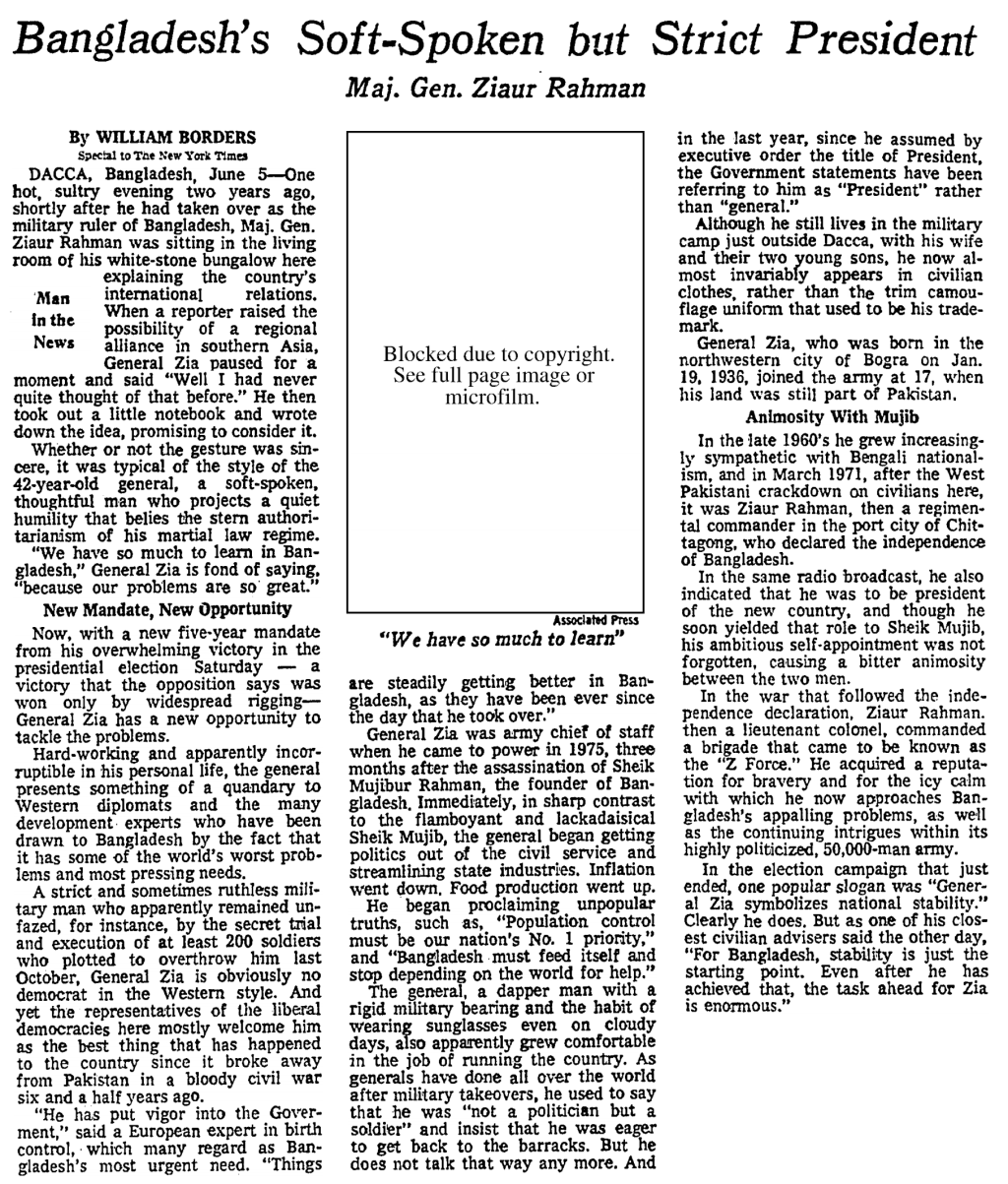
Bangladesh’s Soft‐Spoken but Strict President
One hot, sultry evening two years ago, shortly after he had taken over as the military ruler of Bangladesh, Maj. Gen. Ziaur Rahman was sitting in the living room of his white‐stone bungalow here explaining the country’s international relations. When a reporter raised the possibility of a regional alliance in southern Asia, General Zia paused…
-
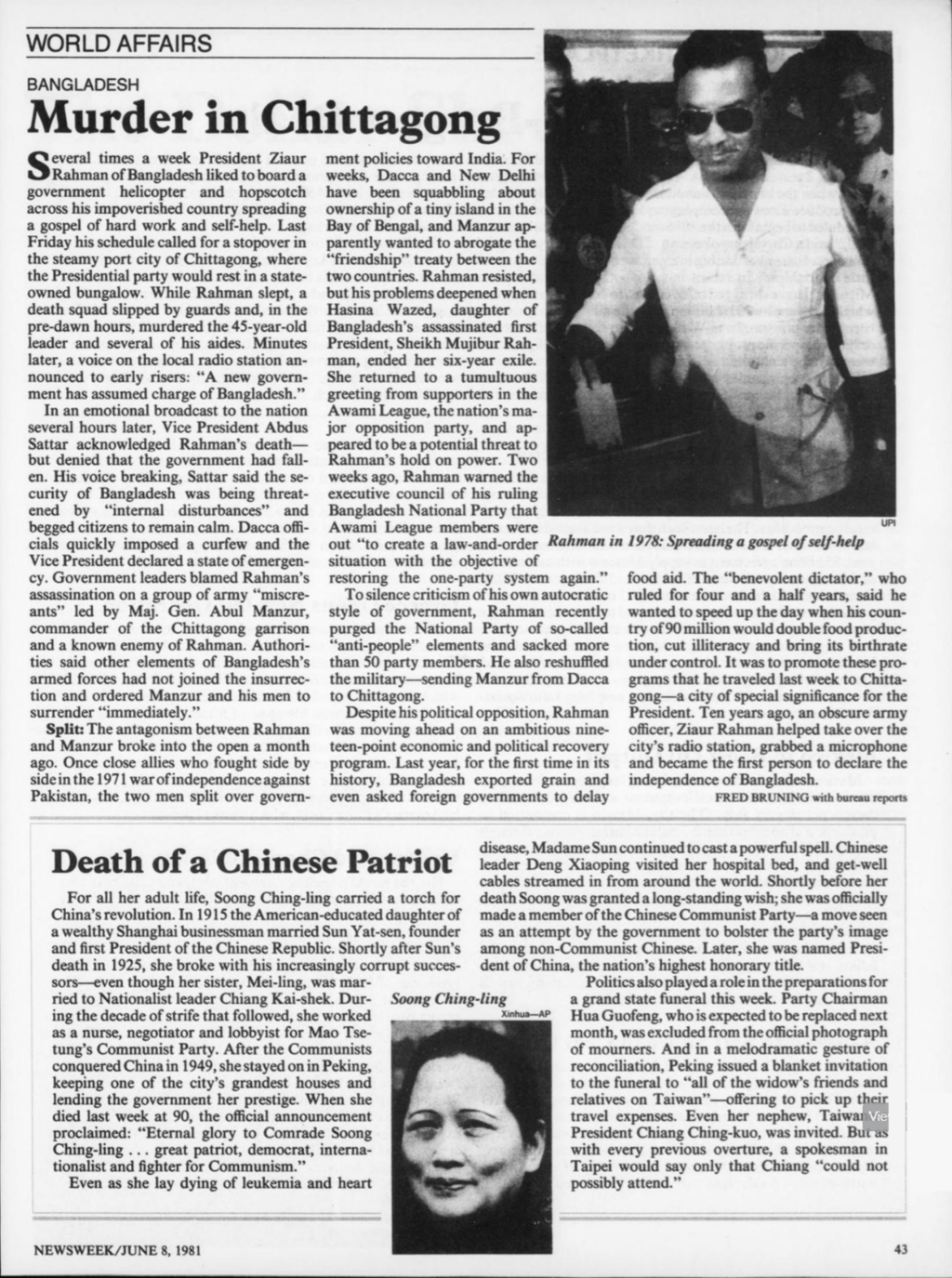
Murder in Chittagong
FRED BRUNING, Newsweek (June 8, 1981) Several times a week President Ziaur Rahman of Bangladesh liked to board a government helicopter and hopscotch across his impoverished country spreading a gospel of hard work and self-help. Last Friday his schedule called for a stopover in the steamy port city of Chittagong, where the Presidential party would…
-

President leads from the front
The Guardian (December 31, 1979) PRESIDENT ZIA faces the task of introducing reforms of land tenure, education, and law in a country that has been busy over the last eighteen months restoring democracy. Over a little canal-digging, he tells Peter Niesewand: “This is our own revolution.” THE WEATHER pattern seemed to be changing in Bangladesh,…
-
Ziaur Rahman’s legacy: Puzzle, lesson and tragedy
Zia has gone through an almost Darwinian process of selection through the war with Pakistan and coups in Bangladesh. He has never denigrated politicians as a class – which is itself typical of the present day military rulers of many third-world countries. On the contrary, he has shown adroit political skills in bringing together diverse…
-
About the verdict on Colonel Taher trial
While giving the verdict on the legality of the punishment of Colonel Taher, the high-court bench of Justices Shamsuddin Chowdhury Manik and Zakir Hossain declared that the whole trial process was illegal and it was in fact a cold blooded murder of Taher by Late president Ziaur Rahman. What high-court did to come to this…
-
Ziaur Rahman: the kind of statesman we need now
Today is the 30th death anniversary of President Ziaur Rahman. This anniversary comes at a time when Zia, his image, contribution and his philosophy are under the fiercest attack ever. After decades of relentless attack on Zia, the war hero and Zia the statesman, after abysmal failure of Zia’s party to portray him appropriately and…
-

Bangladesh Recovers calm after political upheaval
William Borders, New York Times (December 7, 1975) One month after the latest political convulsion in this critically poor country, calm has returned to its daily life as the ruling military junta moves toward relaxing its strict control. In the overcrowded marshy countryside, where a relatively good rice harvest is just getting underway, the armed…
-
Poor But Hopeful: Bangladesh has not collapsed, after all
Kevin Rafferty, The New York Times (February 29, 1976) Bangladesh is not merely poor, it is the poorest of developing countries, but for the first time in its five years of independence, there is hope for a better future. The change has come unexpectedly because, following the assassination last August of Sheik Mujibur Rahman, the…
-

Zia Assassination Reverberates through South Asia
WILLIAM BORDERS, Special to the New York Times (June 8, 1981) Beyond its far-reaching consequences in Bangladesh, the assassination of President Ziaur Rahman has had considerable repercussions all over South Asia. In a region where stability is often elusive and democracy is fragile, governments and embassies have spent much of the week since President Zia…
-
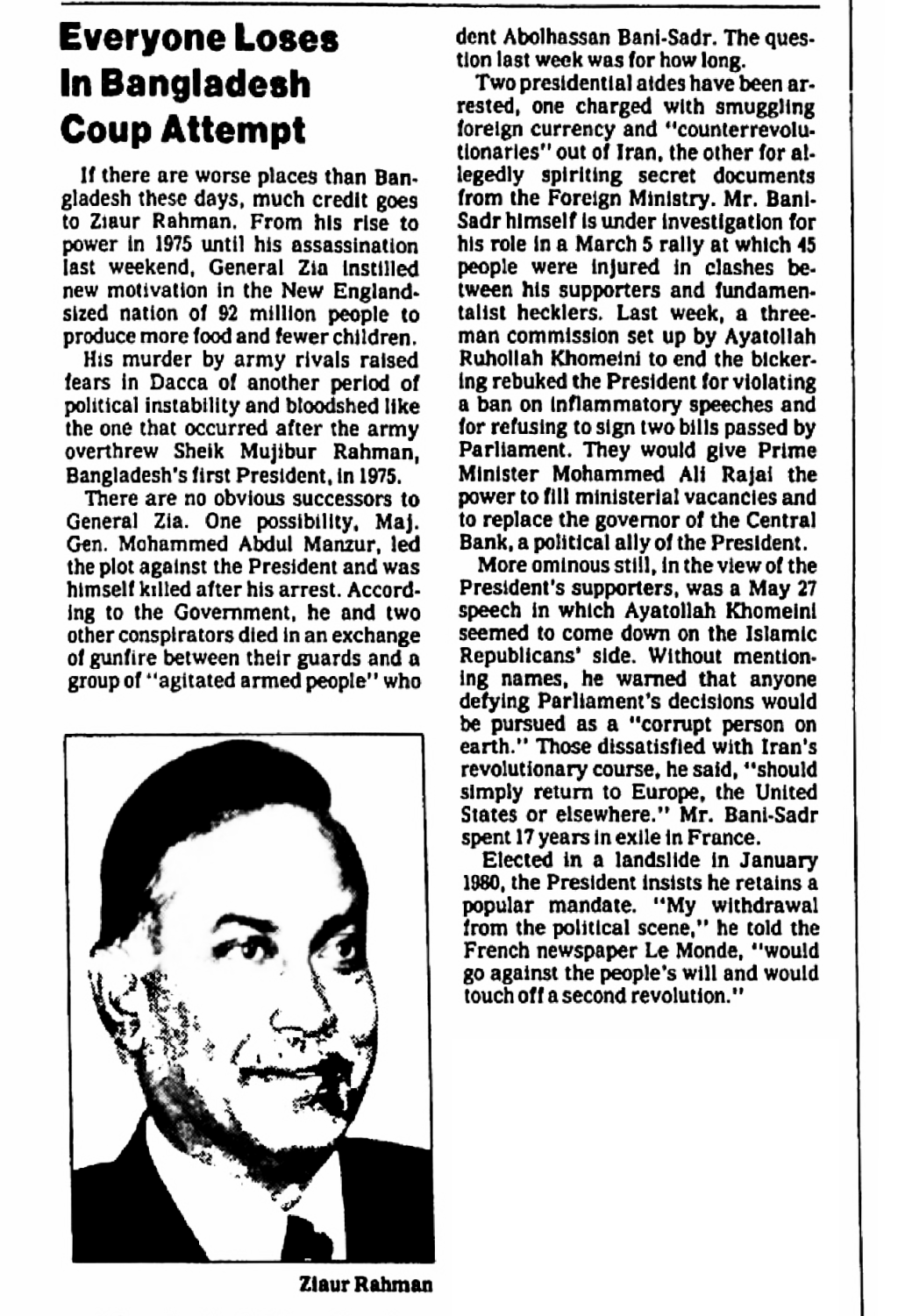
Everyone Loses In Bangladesh Coup Attempt
The New York Times (June 7, 1981) If there are worse places than Bangladesh these days, much credit goes to Ziaur Rahman. From his rise to power in 1975 until his assassination last weekend, General Zia instilled new motivation in the New England-sized nation of 92 million people to produce more food and fewer children.…
 Zia Archive