
Category: In International Media
-
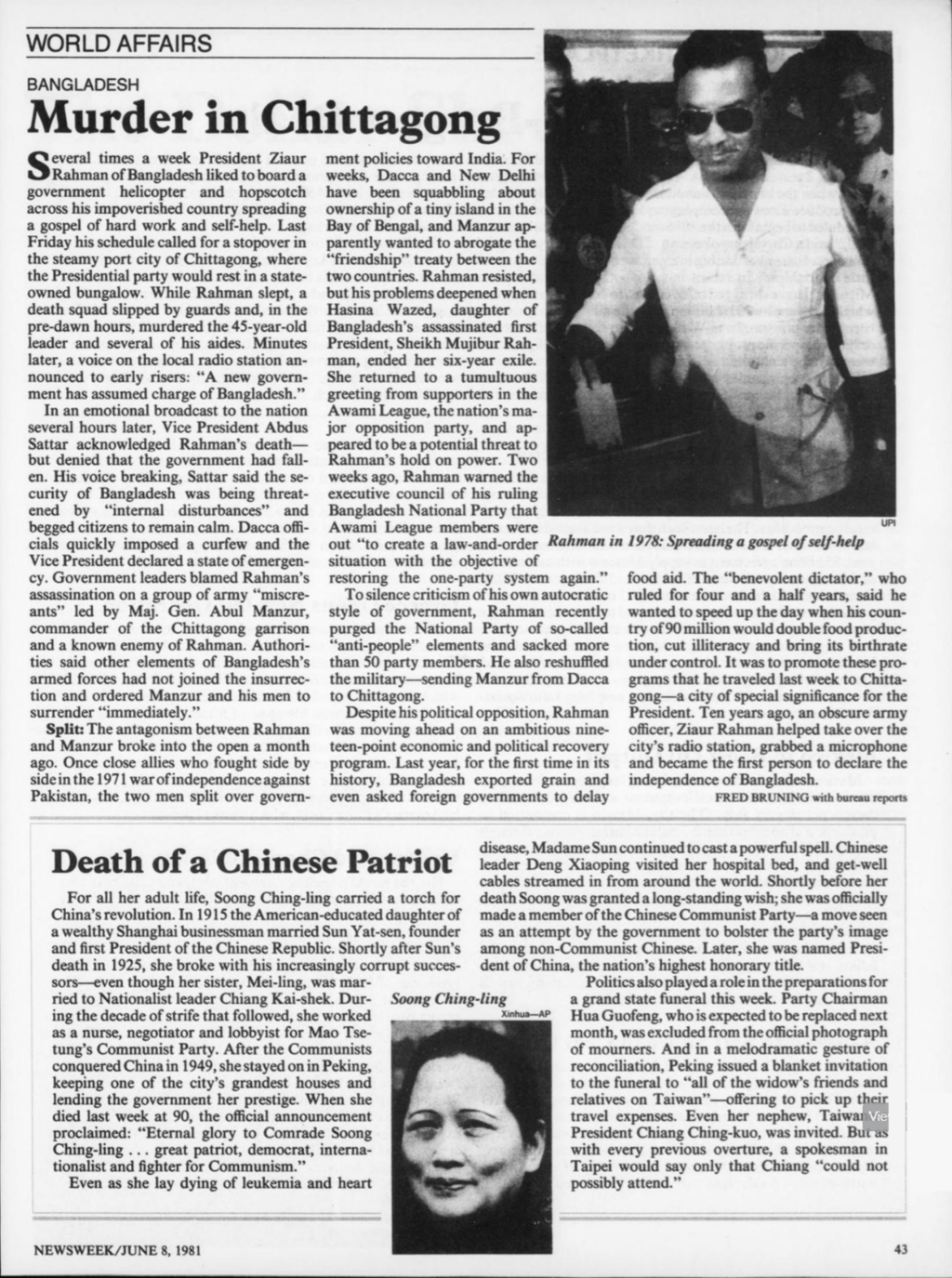
Murder in Chittagong
FRED BRUNING, Newsweek (June 8, 1981) Several times a week President Ziaur Rahman of Bangladesh liked to board a government helicopter and hopscotch across his impoverished country spreading a gospel of hard work and self-help. Last Friday his schedule called for a stopover in the steamy port city of Chittagong, where the Presidential party would…
-

The Basic Problems of Bangladesh
The Times Editorial (June 19, 1980) Bangladesh was born but of Indian intervention and Pakistani inability to keep together two parts of a country that was divided by everything but the religion that was deemed to have. brought the country into being. The severance of East Pakistan and its emergence as Bangladesh was celebrated as…
-
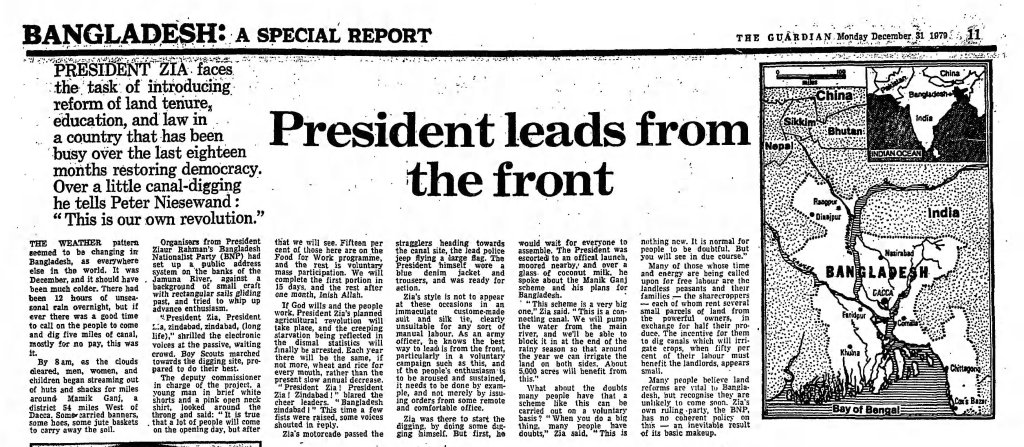
President leads from the front
The Guardian (December 31, 1979) PRESIDENT ZIA faces the task of introducing reforms of land tenure, education, and law in a country that has been busy over the last eighteen months restoring democracy. Over a little canal-digging, he tells Peter Niesewand: “This is our own revolution.” THE WEATHER pattern seemed to be changing in Bangladesh,…
-
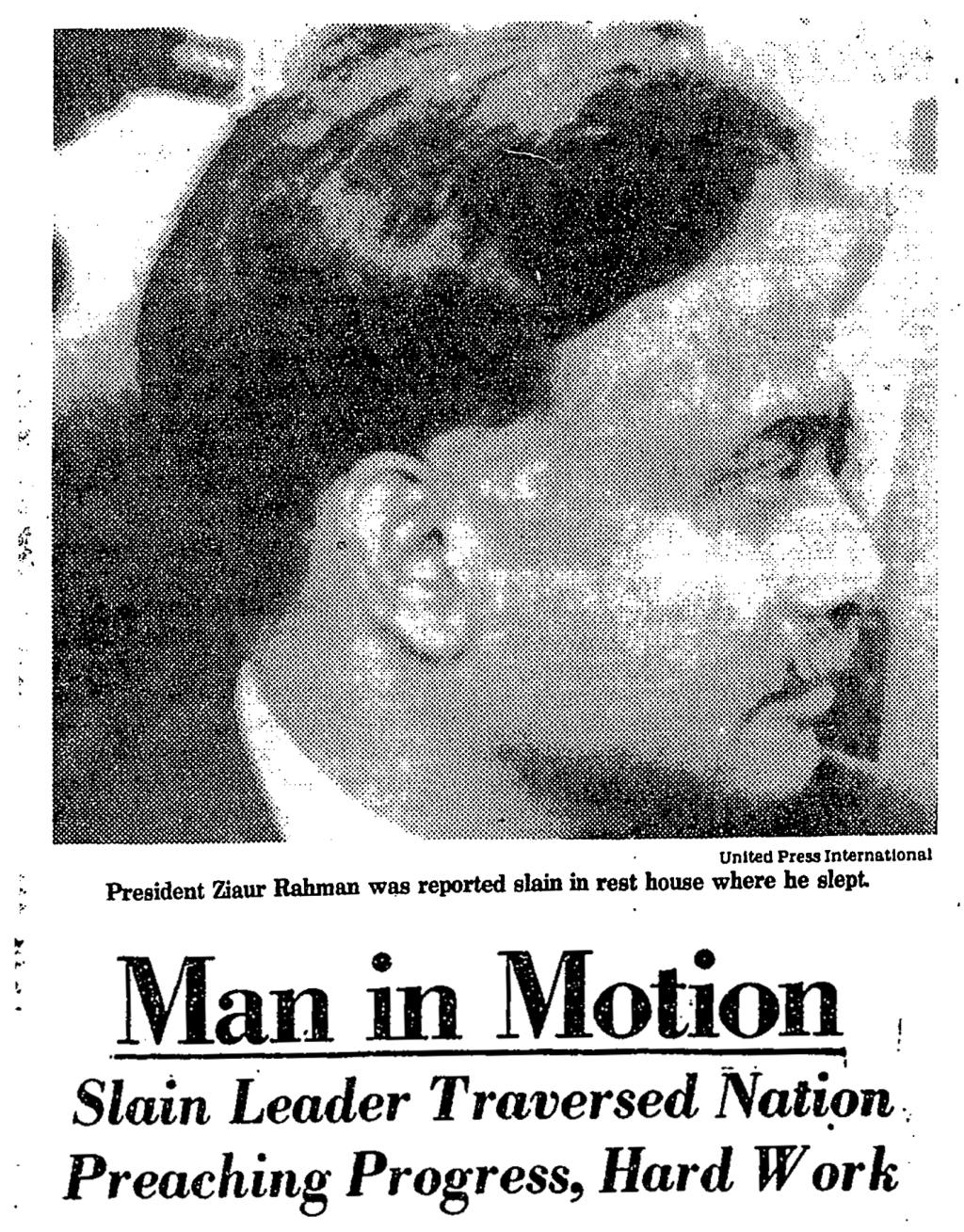
Man in Motion: Slain Leader Traversed Nation Preaching Progress, Hard Work
Stuart Auerbach, The Washington Post (May 31, 1981) The Slain president of Bangladesh, Ziaur Rahman, liked to move out among his people- As many as 20 days a month he headed by helicopter from Dacca to some remote village. Usually, one village wasn’t enough for the short, trim Zia. Dressed in a bush shirt, he…
-
Bangladesh Wooing Businesses
James P. Sterba, The New York Times (April 9, 1979) After an unsuccessful experiment with socialized industry, Bangladesh has begun courting private enterprise, both foreign and domestic, in an effort to stimulate its economic growth and development. Offering an almost inexhaustible supply of the world’s cheapest labor, abundant supplies of natural gas, virtually untapped seafood…
-

Economic Hope For Bangladesh
Kevin Rafferty, New York Times (October 10, 1976) Which Asian country last year achieved double‐digit economic growth? It was certainly not Japan, which is still staggering out of recession and was thankful to turn in a positive 2 percent growth after a 1.2 percent shrinkage in 1974. Nor was it Singapore or Malaysia or any…
-

Bangladesh Recovers calm after political upheaval
William Borders, New York Times (December 7, 1975) One month after the latest political convulsion in this critically poor country, calm has returned to its daily life as the ruling military junta moves toward relaxing its strict control. In the overcrowded marshy countryside, where a relatively good rice harvest is just getting underway, the armed…
-
Poor But Hopeful: Bangladesh has not collapsed, after all
Kevin Rafferty, The New York Times (February 29, 1976) Bangladesh is not merely poor, it is the poorest of developing countries, but for the first time in its five years of independence, there is hope for a better future. The change has come unexpectedly because, following the assassination last August of Sheik Mujibur Rahman, the…
-

Bangladesh: Since independence, just failure
WILLIAM BORDERS, The New York Times (November 9, 1975) At a high‐level White House meeting nearly four years ago, Ambassador U. Alexis Johnson, trying to explain to his colleagues what a grim future faced Bangladesh, described the new nation as an “international basket case.” Since then, life in Bangladesh has worsened: And there is no…
-
President Zia is assassinated: Time
Time Magazine (June 08, 1981) Ten years ago this spring, young Major Ziaur Rahman broadcast an electrifying message from a clandestine radio in the East Pakistan city of Chittagong, proclaiming a rebellion against West Pakistan that ultimately created the nation of Bangladesh. Late last week there was another voice on the radio from Chittagong, announcing…
 Zia Archive