
Author: Editor
-

U.N. to Start Talks on How to Assist Third World
Bernard D. Nossiter, The New York Times (August 22, 1980) Secretary of State Edmund S. Muskie and President Ziaur Rahman of Bangladesh are among the officials due here next week when rich and poor nations begin a new effort to aid economies in Asia, Africa and Latin America that have been depressed by the high…
-
Sri Lanka and Bangladesh Reach Accords During Visit by Rahman
The New York Times (November 11, 1979) President Ziaur Rahman of Bangladesh ended a visit here this week by signing new agreements with Sri Lanka on economic and technical cooperation and shipping. The President told reporters shortly before his departure: “We are very satisfied with our visit. We have opened our hearts to each other.”…
-

Where to Look for Aid: New Ideas for Third World
Bernard D. Nossiter, The New York Times (August 29, 1980) Maj. Gen. Ziaur Rahman, the President of Bangladesh, has been uttering heresy at the United Nations bargaining session between rich and poor. Unlike most spokesmen here for developing countries, General Zia does not think that the task of aiding the poor is exclusively a Western…
-

Ziaur Rahman was strict leader who tried to give nation direction
Les Ledbetter, The New York Times (May 31, 1981) When Maj. Gen. Ziaur Rahman seized power in Bangladesh six years ago, he was hailed as the strict leader that the struggling nation needed. After the coup that gave him the presidency, the soft-spoken military man was described as hard-working and incorruptible in his personal life…
-

Without Zia, Less Chance for the ‘Peaceful Revolution’
WILLIAM BORDERS, The New York Times (June 7, 1981) If the population of the entire world were squeezed into the continental United States, that land would be about as densely populated as Bangladesh is now. That is the kind of illustration prized by the legions of aid and development experts who for years have been…
-
Bangladesh’s Soft‐Spoken but Strict President
One hot, sultry evening two years ago, shortly after he had taken over as the military ruler of Bangladesh, Maj. Gen. Ziaur Rahman was sitting in the living room of his white‐stone bungalow here explaining the country’s international relations. When a reporter raised the possibility of a regional alliance in southern Asia, General Zia paused…
-

Memoir: Zia’s wristwatch
AKM Maidul Islam One day I was in a helicopter with President Zia. It was around half-past nine that day. But the wristwatch of our President was showing half-past seven. So I told him, sir, your wristwatch is not working. He laughed and told me, ‘I had a good watch actually but I lost it…
-
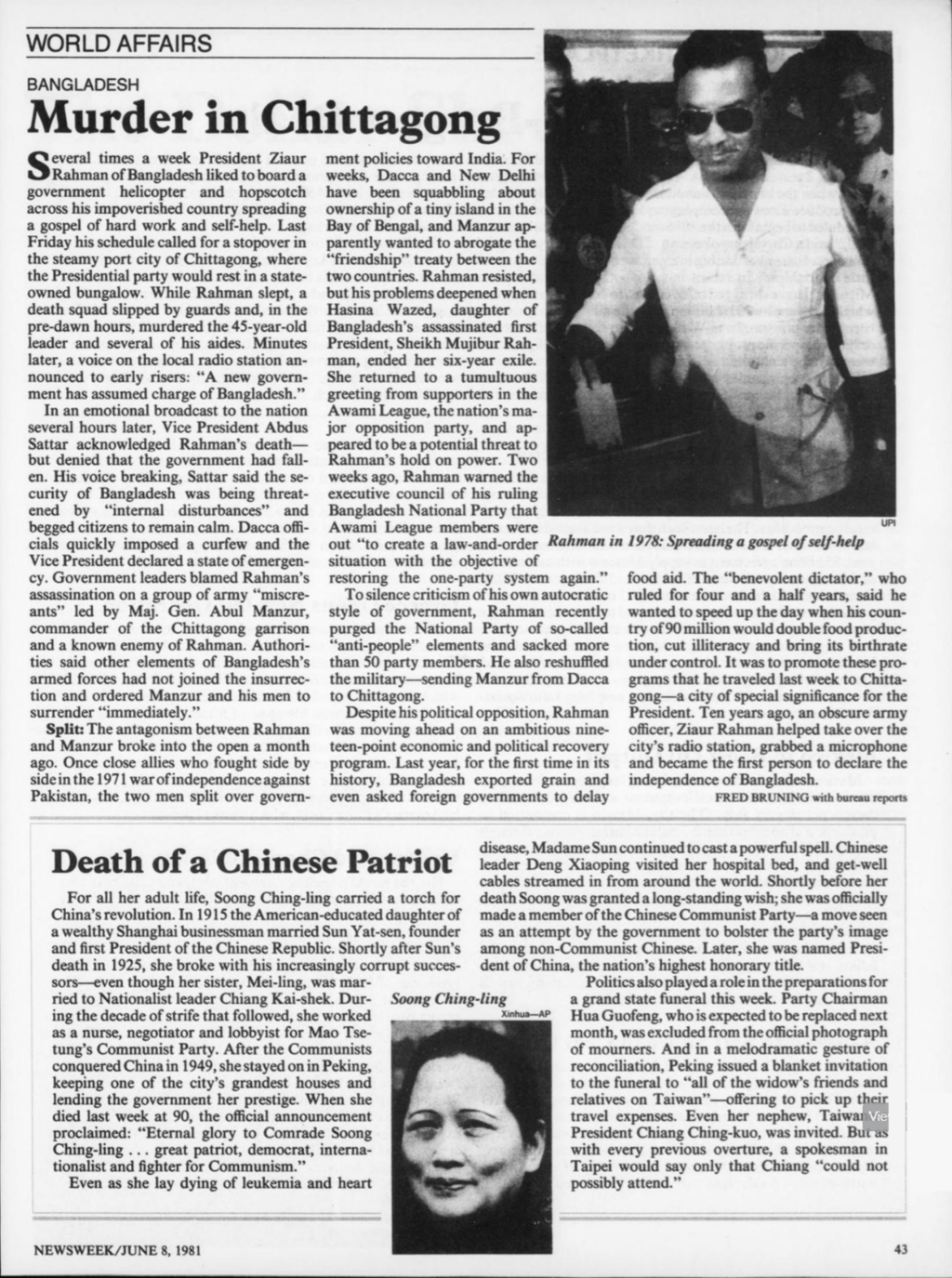
Murder in Chittagong
FRED BRUNING, Newsweek (June 8, 1981) Several times a week President Ziaur Rahman of Bangladesh liked to board a government helicopter and hopscotch across his impoverished country spreading a gospel of hard work and self-help. Last Friday his schedule called for a stopover in the steamy port city of Chittagong, where the Presidential party would…
-

The Basic Problems of Bangladesh
The Times Editorial (June 19, 1980) Bangladesh was born but of Indian intervention and Pakistani inability to keep together two parts of a country that was divided by everything but the religion that was deemed to have. brought the country into being. The severance of East Pakistan and its emergence as Bangladesh was celebrated as…
-
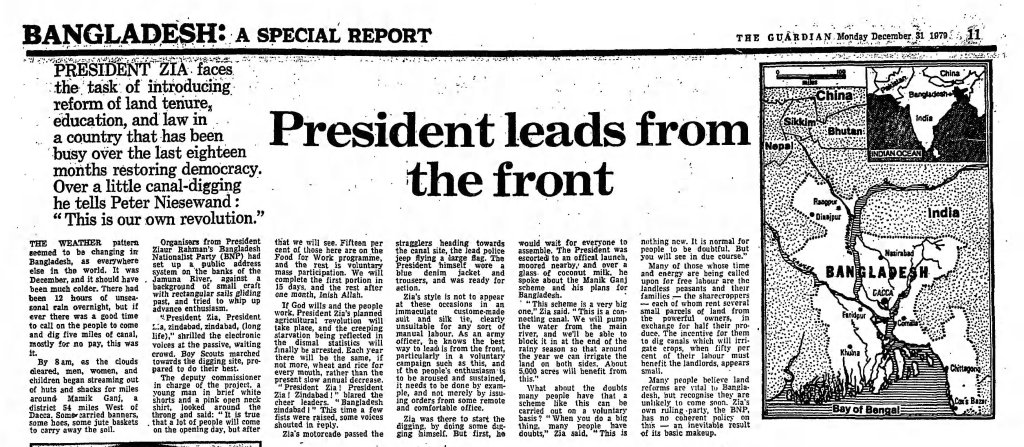
President leads from the front
The Guardian (December 31, 1979) PRESIDENT ZIA faces the task of introducing reforms of land tenure, education, and law in a country that has been busy over the last eighteen months restoring democracy. Over a little canal-digging, he tells Peter Niesewand: “This is our own revolution.” THE WEATHER pattern seemed to be changing in Bangladesh,…
 Zia Archive