
Author: Editor
-

Indira Gandhi’s condolence
India Prime Minister Indira Gandhi expressed shock at the assassination of Bangladesh President Ziaur Rahman, whom she called a man of ‘statesmanlike vision.’ We are shocked at the tragic news of his excellency President Ziaur Rahman’s assassination. I have always condemned the politics of murder. President Ziaur Rahman led his country with distinction, giving special…
-

President Reagan on Zia’s death
President Ronald Reagan of the United States of America, sent a message to Acting President Abdus Sattar of Bangladesh on the Death of President Ziaur Rahman immediately after he received the information on May 31, 1981. The message read: I was shocked and deeply grieved to learn of the assassination of President Ziaur Rahman. The…
-

The Times interview: Bangladesh and the hazards of democracy
President Zia ur-Rahman of Bangladesh leaned forward in his armchair, his eyes alight with enthusiasm: “Everybody knows our problems in this country are terrible but we have our muscles and we can work, dig and grow. We can pull ourselves up. With our, bare hands we can achieve great things.” No one knew better than…
-
The Times Biography: Zia Ur-Rahman
The Times: Biography (June 1, 19781) President Zia ur-Rahman of Bangladesh, who was killed at the age of 45 in Chittagong on May 30 during an insurrection against the government, had been the effective instrument of power in the country since soon after the overthrow and assassination of Sheikh Mujibur Rahman by a group of…
-

A rush of blood leaves Bangladesh on the brink
John Cunningham, The Guardian (June 1, 1981) President Ziaur Rahman’s luck fatally ran out in a hail of bullets in the government rest house just before dawn on Saturday. The province on the East flank of Bangladesh which takes its name from the port city he was visiting, mocks the imprint of national stability which…
-
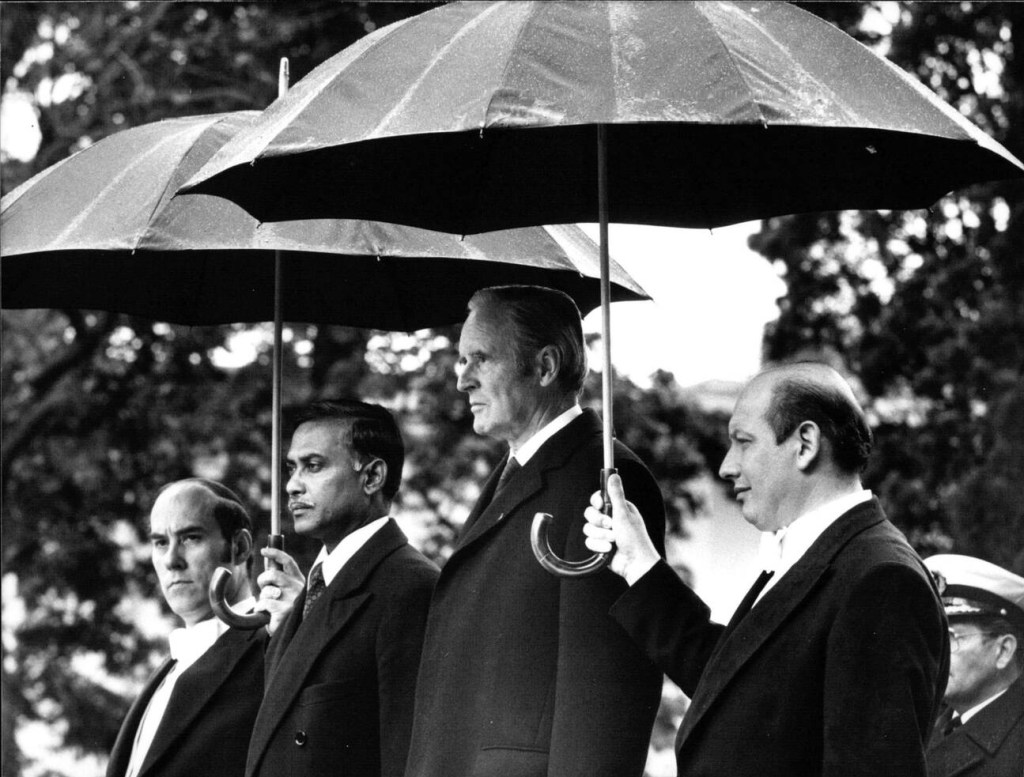
A moderate nationalist who wanted to lift his country out of extreme poverty
Gerard Viratelle, Le Monde (June 01, 1981) Only 46 years old, but in power since November 1975, General Ziaur Rahman, familiarly known in his country by the diminutive of Zia, was a moderate nationalist and a man of authority. Always calm, neatly dressed and with eyes often hidden behind tinted glasses, his “coldness” contrasted with…
-

A Tragedy for Bangladesh
The Times Editorial (June 01, 1981) The killing of President Zia-ur Rahman is a shattering blow to peace and good government in Bangladesh, likely to throw the country into despair at the unending military rivalry from which the country has suffered from its birth. Nothing that is known of the rebel leadership in Chittagong promises…
-

Don’t Write Off Bangladesh
The New York Times Editorial (June 12, 1981) At first glance, the recent news from Bangladesh seems only to confirm that nation’s pathetic image. Born out of a fracturing of Pakistan only a decade ago, Bangladesh early on gained a reputation as an international ”basket case,” a metaphor for misery and hopelessness. Only charity and…
-

Analysis: The Garments Takeoff
Mushtaq Husain Khan [This article is extracted from a working paper of Professor Mushtaq Husain Khan of SOAS University of London to allow the readers to understand the story of Bangladesh’s RMG industry in the late 1970s and the role of Ziaur Rahman] The growth of the ready-made garments industry in Bangladesh has often been…
-

Bangladeshi Leader Tireless in Pep Talks to People
Michael T. Kaufman, The New York Times (July 28, 1980) As he does three or four times every week, President Ziaur Rahman recently flew to villages and country towns in Bangladesh to exhort cheering crowds to produce more food and have fewer children. In this river port, the 43-year-old President walked into crowds waiting for…
 Zia Archive